


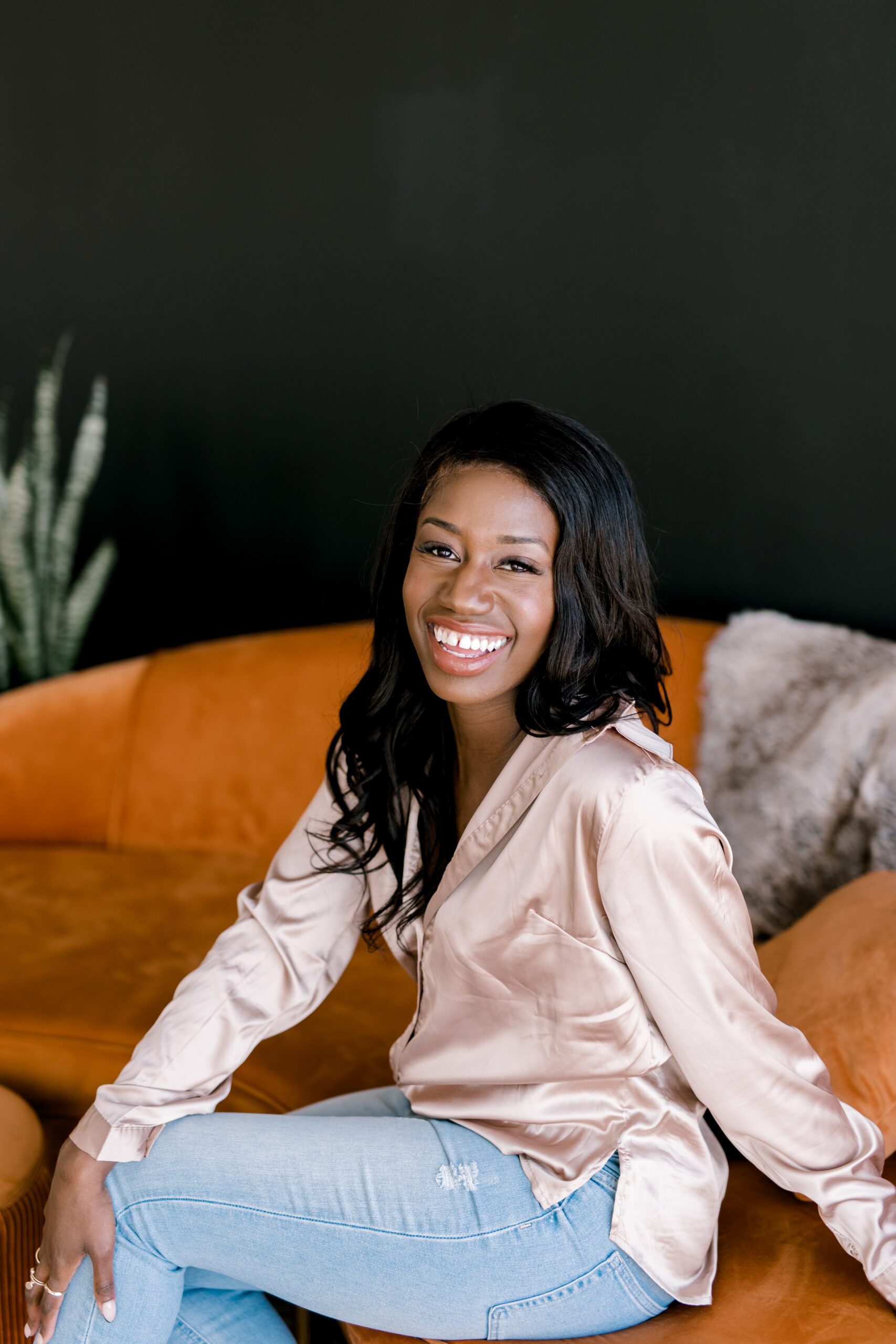
Today we have another lovely guest training on the podcast, this time with Akua Konadu. Akua and I met a few years ago when we were both speaking at the Creative Educator Conference. She’s the host of two incredible podcasts, which you’ll hear her talk about as she introduces herself. When I was planning these guest trainings (originally for my maternity leave, though I’ve been airing them more sporadically now), Akua immediately came to mind as someone who could offer such a valuable perspective on interviewing as a podcast host and hosting better podcast interviews. She is a truly strong interviewer, and storytelling is something she teaches in her business — so she lives and breathes this stuff.
If you’ve started a podcast and have done even a handful of interviews, you know interviewing is a real skill. It’s not as simple as reading questions you wrote ahead of time. It’s a conversation. And it can feel overwhelming at first, and sometimes, it can feel like you’re asking a question but already thinking ahead to the next one and not fully hearing their answer. There are a lot of little pitfalls like that that new (and even seasoned!) podcasters can fall into.
Akua is here to help you avoid those traps and grow your show by becoming a better interviewer. She’s sharing five powerful tips for better podcast interviews, plus some storytelling strategies that are absolute gold. Storytelling is her specialty, and you’ll really hear that shine through.
So whether you’re brand new to podcasting or you’ve been interviewing guests for years, these are the kinds of things we can all easily miss. I know you’re going to learn so much from her.
LISTEN TO THIS EPISODE NOW:
Subscribe & download the episode to your device: Apple Podcasts | Spotify | YouTube | iHeartRadio
Search for episode 327!
Hello, hello! I am so excited to be tapping into the Breakthrough Brand Podcast this week. My name is Akua Konadu, and I'm a host of not one, but two podcasts. Number one, the Unbreakable Business Podcast, powered by HoneyBook, where we lean into the untold stories of entrepreneurship. And then my other podcast, which is all about life, Here’s the Tea with Akua, where we are all about making uncomfortable conversations more comfortable.
So as somebody with two podcasts, I have done countless interviews, and it has been such an incredible and really fun experience, and we have seen a lot of success. I’m really excited today to be talking with you all about how to become more strategic with interviewing. As I have learned about myself, I’ve naturally fallen into the podcasting realm, but what I’ve learned is that interviewing is definitely a skill.
As you lean more into that journey, it’s really about refining these skills and exercising that muscle so that you feel more confident in your interviews, but also so that your interviews make a major impact that will actually grow your show. I’m really excited to share some tips with you that I think have been so phenomenal for me in my podcast journey and have really made a difference in my growth. That’s what we’re going to dive into.

So here are some interview tips that are going to lead to breakthrough conversations. Are you ready? Let’s get into it.
1. You Need To Research Your Guest & Prep Like a Pro
My number one tip is to research your guest. You want to prepare like a pro. Now, prepping for everybody can really depend on your personality. For example, if you are type A, maybe you are somebody that’s really thorough, you like to have a lot of questions laid out. It really just depends on your personality and the goal of your show.
For me, I am not like that. I’m actually type B. Most of my interviews, naturally, I have winged, but I have prepped in a way that has allowed me to really kind of just wing my episodes. I’ll have questions, but naturally, depending on their answer, I’ll end up not using my questions.
Here are some examples of how I prep for my shows.
First, what is the main goal of your show?
Really go back and revisit that. For me, with my personality and for both of my shows, the underlying goal is I love to have really raw, real, unfiltered conversations. So I know that about myself and that’s the main goal of the show.
I also do a really deep dive into getting to know the guest.
I listen to past interviews, number one, see how they do on video, see how they do in interviews in general, but also to really get a good feel for their personality and how they answer questions. We do deep dives into their social. I’ll try to go and find some really old social media posts where they’ve shared little hints of their story but maybe haven’t fully emphasized it.Then I think, “Okay, we can lean into that.” I Google them, read articles if they’ve been featured in anything—really taking that time to get to know who they are as an individual and also who they are as a business owner. That prep is super helpful.
In my prep documents, we always have their bio, of course, but I’ll also have an outline. And then, if there are any notes where I’m like, “Ooh, I really want to lean into this specific piece of their story,” I’ll bring it up.
An example of this in action
So, for example, we had an episode on the Unbreakable Business Podcast with a woman who’s a PR expert. That is mainly what she is known for. If you Google her name, it’s PR. If you Google interviews, it’s all about PR. That’s great, that’s what we wanted her on the show for, but I wanted to come at it from a more unique angle, where people are either able to learn something completely different from what she generally talks about with PR, or we can tie more of her personal journey into that.
So we dug deep into her social media and found this really random social media post where she was featured in a magazine at nine years old and we opened with that. That was immediately the hook of the episode: asking her about that specific moment when she found out she was in this magazine and how she got into the magazine. I knew we’d be able to capture our listener’s attention right away by bringing that up.
On top of that, when you catch them a little bit off guard like that, it lets down the guest’s nervousness, and then you start to see the real person—who they are, not the more buttoned-up interviewee. I get to see them as their whole person and their humanity, and that’s why I research in the way that I do.
Read more: 3 Easy Hacks To Grow Your Show With Podcast Guests
2. Lead with Curiosity, Not Control
The next tip that I want to share is to lead with curiosity, not control. Like I said before, I’m a type B, so no conversation is ever the same. Always stay open to where the conversation naturally flows.
Even if you’re someone who’s like, “Okay, I can’t do that, Akua,” maybe just start with one question, and then depending on their answer, let that lead into another question or a follow-up. Really stay flexible, because one thing that I don’t enjoy as a listener of a show is when it’s just very “interview-y.” I really want it to be a conversation.
So come in with strong openers and direction—just not with super rigid questions. Because sometimes when you ask rigid questions, they’ll just give you one straightforward answer and that’s it. And of course, it’s okay if you ask follow-ups, but I want to see them as an individual. I want them to share as much as they can that’s relevant to the question.
That’s what I do: I lead with curiosity and really follow the conversation. A lot of the time I’m like, “Ooh, I really like what this person just said here, let’s lean more into that,” and I’ll take the conversation in a different direction. And that’s okay, because that will honestly lead to a much richer, deeper conversation that can truly go very far.
Let those emotional moments really land before jumping into the next question or the next topic. Really give that person the space to share whatever it is that they’re feeling or whatever it is they want to share. And then, if you want to know more about it, lead in with curiosity—because then you get to know more about the person, and that helps your audience get to know more about them as well.
Read more: 3 Advanced Podcasting Tips That Will Boost Your Downloads, Save You Time, and Make More Money
Tips from a Storytelling Strategist
If you don’t know this, I’m a storytelling strategist. I love helping business owners lean more into their story and lean more into their gifts to actually create content that aligns with who they are, connects with their audience, and makes it easier for them to sell their products and services. So it would be unjust for me not to share any storytelling tips with you.
These are some storytelling tips I use to really pull out depth in interviews because, again, that’s what I’m looking for: untold stories of entrepreneurship, making uncomfortable conversations more comfortable. So you really have to focus on stories.
Instead of having people share a story that starts at the very beginning, I always ask a question that’s in the moment. So instead of saying, “What’s your advice for somebody starting out?” or “How did you get started in your business?” I’ll say, “Can you share with me a time in your business where you felt like you were going to give up?” or something like that.
It forces them to be in a moment, like what I said earlier, where they’re now placing themselves back in that situation (how they felt, what they were thinking), and that’s what they’re going to share.
That is what I always, always want to do: how can I bring out the emotions and the transformation? That’s what I love to talk about and really lean into as I’m doing these interviews. The way I do that, like I said, is by inviting them into a question that starts in the moment and isn’t very generic. Because when they answer a question that starts in the moment, they’ll remember something else that’s been stored away in their brain and think, “Oh my gosh, I want to talk about this as well.”
And again, it just leads to such a beautiful flow of the conversation. That’s something that has been really impactful for me as a storytelling strategist—really starting in that moment.

3. Make It Feel Like a Conversation
If you’ve been podcasting for a while, this is likely not new to you. But what I love so much is when guests ask me as the host questions as well. There have been times I’ve had episodes that absolutely caught me off guard, but those have led to some of my best-performing episodes because it feels like a conversation. It’s not just a one-way conversation. It’s not just me asking the question and them replying.
When they’re also asking me questions, or I give my reaction and add to the conversation, that makes such a big difference. It makes it feel so much more natural and so much more meaningful.
So remember that you, as the interviewer, are also a person who can equally contribute to the interview you’re giving. Because again, it starts to naturally turn into that conversation where, when you’re giving that feedback, it will prompt that person to either ask you a question or also add more to the conversation, where it feels like two friends who are just chatting it up.
I mean, I’ve had guests where it was my first time meeting them, and some people would think that I actually have a relationship with this person, but I really don’t. That really helps lower the person’s defenses (like their nervousness, if that’s how they’re feeling).
Read more: 5 Expert Tips for Becoming an Unforgettable Podcast Guest
4. Don’t Get Caught Up In “Insider Talk” Or Jargon
Remember to ask those clarifying questions. For example, on the Unbreakable Business Podcast, we obviously focus more on service providers, B2C. We had a guest come on the show who’s mainly B2B. And so he was saying lingo and things that may not be completely relevant, or maybe people working in the B2C realm may not know. So I made sure to stop and then give people that additional context, and then he continued to go on.
Anytime I knew there was going to be a gap in what he was saying, where our audience might not understand, I would always follow up or pause him in the middle while he was sharing his answer, where I could tell he was going to take a second. You can tell, when you’re giving the interview, where you’re like, “Ooh, I can interject here,” because I could tell he was about to give a pause.
So then I said, “Okay, just some added context,” and then I would share that. And he would be like, “Yes, yep, absolutely,” and then he would continue on with the story, so it was really easy for our listeners to follow along with what he was sharing.
Don’t be afraid to ask those clarifying questions. Don’t be afraid to just take a pause and say to them, “I just want to make sure that our listeners understand here,” and then lay it out for them so they understand, and then the person can pick up where they left off.
I always do that, and it has made such a great difference, because I want to make sure that every single person listening to the show really does feel like they got something out of it.
So always lead with that clarity. If you have to pause, that’s okay. If you have to ask them clarifying questions, that’s okay. If you need to have them stop for a second, that’s okay too. As you interview more and really exercise those skills, it’ll become a lot more natural to you.

5. Have a Really Clear CTA (Call-to-Action)
Make sure to end strong. Have a really clear CTA. I know it’s simple, but it’s just so important.
I really like to have guests hold themselves accountable, whether it’s asking them questions for reflection, or saying, “If you remember one thing from today…” And I always say, “Head to my socials so we can continue this conversation.” I absolutely love that. I think it’s super helpful.
Leave listeners with clarity and not just with the content. That’s where you can ask for reviews, or I’ve seen some people do a quick episode recap at the end. Whatever it is, don’t just leave them with the content—leave them with some form of action they can take.
So those are all of my tips that have really made such a big difference and have led to breakthrough conversations on the podcast. Thank you all for tuning in.
Advice from a Storytelling Strategist for Better Podcast Interviews
As a storytelling strategist, what has helped me become such a strong interviewer is really understanding what my storytelling style is. I have a quiz called “What Is Your Storytelling Style?” This quiz is personalized to your type and gives you incredible tips, resources, and podcast episodes to listen to that reflect your storytelling style.
I really want to encourage you to take that quiz because it’s going to help you figure out what your natural strengths are, especially as an interviewer, and help you learn how to use them more intentionally.
You can connect with me at @akuakonadu_ on Instagram. I love chatting in the DMs. My website is here and you can also find me on the Unbreakable Business Podcast, powered by HoneyBook. We have new episodes that come out on Wednesdays.
Links Mentioned:
Follow Akua on Instagram
Listen to Akua's Podcast: The Unbreakable Business Podcast hosted by Honeybook and Here's the Tea with Akua
Sign up for Podcast Success Blueprint
Not sure which template is right for you? Take the quiz!
Listen to the Breakthrough Brand Podcast


Thanks to our blog sponsor, Christian Healthcare Ministries (CHM)!
CHM is a faith-based alternative to health insurance—at about half the cost. You can enroll at any time and join a proven, faith-based solution that’s both reliable and affordable.
My family has been CHM members for over 5 years, and their maternity care shared all expenses for all 3 of my children’s births—from c-section to home birth. They even shared costs for key parts of prep and postpartum care, like pelvic floor physical therapy and lactation consulting.
Beyond birth, CHM has helped us through ER visits, surgeries, and procedures. Those bills were shared by other CHM members, leaving us responsible only for our monthly contribution.
I can’t recommend Christian Healthcare Ministries enough! It’s more than financial help—it’s also spiritual support when you need it most.
Learn more here! And if you’d like to hear our full story, check out episode 305 of The Breakthrough Brand Podcast, where Adam and I dive into our experience with CHM.


